



Picking what runs behind your website matters more than most think these days. Come 2026, developers still lean heavily on just two tools: Laravel takes one path, while Node.js walks another. One grows from PHP roots, the other thrives on JavaScript speed. Each handles big projects well – yet how they work shapes who uses them. Project goals tend to decide which fits best.
Here’s a look at Laravel beside Node.js – how they handle speed, growth needs, building pace, tools around them, situations where each shines. One shapes fast web apps, the other powers real-time systems. Think busy servers versus quick turnarounds. Each brings different strengths depending on what the job demands. The choice hinges on project shape, team skill, long-term upkeep. Some favor structure, others need flexibility. Performance shifts based on workload type. Scaling paths differ in approach and effort. Tools exist for both, just spread out differently. Picking boils down to context, not rankings.

What is Laravel?
Laravel is a popular PHP web framework known for its elegant syntax, built-in tools, and strong developer community. It follows the MVC (Model-View-Controller) architecture and provides many features out of the box such as authentication, routing, caching, queues, and ORM through Eloquent.
Laravel is widely used for building web applications, SaaS platforms, and enterprise systems.
- Key Features of Laravel
- MVC architecture for organized code
- Built-in authentication and authorization
- Eloquent ORM for database operations
- Blade templating engine
- Queue and job processing
- Strong security features
- Large ecosystem and community
What is Node.js?
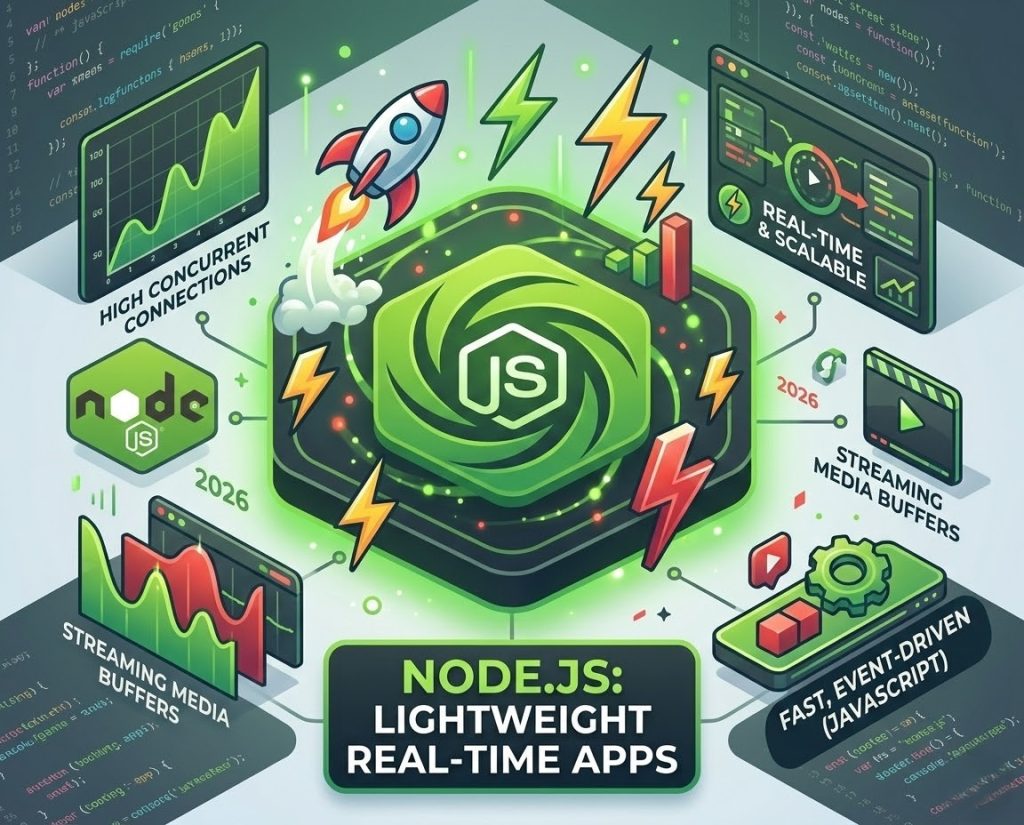
Node.js is a JavaScript runtime that allows developers to run JavaScript on the server side. It is built on Chrome’s V8 engine and uses a non-blocking, event-driven architecture, making it ideal for real-time and high-performance applications.
Node.js is widely used for real-time applications, APIs, microservices, and scalable systems.
Key Features of Node.js
- Asynchronous, event-driven architecture
- High performance for real-time applications
- Same language (JavaScript) for frontend and backend
- Large package ecosystem via npm
- Excellent for APIs and microservices
- Strong scalability support
Laravel vs Node.js: Key Differences
1. Programming Language
Laravel
- Uses PHP
- Mature ecosystem with decades of development
- Great for traditional web applications
Node.js
- Uses JavaScript
- Same language for frontend and backend
- Popular for full-stack JavaScript development
2. Performance
Node.js generally performs better in real-time and high-concurrency applications because of its non-blocking architecture.
Laravel, on the other hand, performs very well for database-driven applications and traditional web systems but relies on synchronous request handling.
Winner: Node.js for high concurrency.
3. Development Speed
Laravel provides many built-in features like authentication, validation, queues, mail, and ORM. This allows developers to build applications faster with less setup.
Node.js often requires combining multiple libraries or frameworks like Express.js, NestJS, or Fastify.
Winner: Laravel for rapid development.
4. Scalability
Node.js was designed for scalable network applications. Its event-driven architecture makes it ideal for applications that handle many simultaneous connections.
Laravel can scale effectively using tools like:
- Redis
- Queue workers
- Load balancers
- Horizontal scaling
However, Node.js naturally fits microservices architecture.
Winner: Node.js.
5. Learning Curve
Laravel is known for its excellent documentation and structured development approach. Developers who know PHP can start building quickly.
Node.js requires understanding asynchronous programming, callbacks, promises, and event loops, which can be challenging for beginners.
Winner: Laravel for beginners.
6. Ecosystem and Community
Both technologies have massive communities.
Laravel ecosystem includes:
- Laravel Forge
- Laravel Vapor
- Laravel Nova
- Laravel Horizon
Node.js ecosystem includes:
- Express.js
- NestJS
- Next.js
- Massive npm package registry
Both ecosystems are extremely powerful, but Node.js has more packages overall.
When to Choose Laravel
Laravel is the best choice when you are building:
- Business applications
- CRM systems
- SaaS platforms
- Content management systems
- E-commerce platforms
- Database-driven applications
Laravel is ideal if you want fast development with built-in features and strong structure.
When to Choose Node.js
Node.js is a better option for:
- Real-time chat applications
- Streaming platforms
- Multiplayer games
- High-traffic APIs
- Microservices architecture
- Real-time dashboards
Node.js excels in handling thousands of concurrent connections efficiently.
| Feature | Laravel | Node.js |
|---|---|---|
| Language | PHP | JavaScript |
| Architecture | MVC Framework | Event-Driven Runtime |
| Performance | Good | Excellent for real-time |
| Development Speed | Very Fast | Moderate |
| Scalability | Good | Excellent |
| Learning Curve | Easier | Moderate |
Which Backend Should You Choose in 2026?
The answer depends on your project requirements.
Choose Laravel if you want rapid development, built-in tools, and a structured framework for building business applications.
Choose Node.js if your application requires real-time communication, high concurrency, or microservices architecture.
In many modern tech stacks, companies even combine both technologies—using Laravel for core business logic and Node.js for real-time services.
Final Thoughts
Both Laravel and Node.js are powerful backend technologies in 2026. Laravel provides a robust, developer-friendly framework, while Node.js offers high performance and scalability for modern applications.
Instead of asking which technology is better, the real question is which one is better for your project.
Choosing the right backend will help you build faster, scale better, and maintain your application more efficiently.

